SECTIONS
peterdohna
related pages
miscellaneous

The Russians passing throught Sehidewitz in the moments previous to
the battle
peterdohna (SEPTEMBER 26, 1813)
| GO TO THE BATTLE IN PICTURES |
INTRODUCTION
This is a fictional battle fought
between the Russo-Prussian
contingents of the Army of Bohemia led, respectively by
Wittgenstein and Kleist, against
the French St-Cyr's XIV and Lobau's I Corps
(re-organized after Kulm).
After the battles of Dresden,
Kulm and the
Katzbach, there was an interlude in
the southern front. Schwarzenberg and Napoleon played a 'cat and
mouse' game, with the first trying to traverse the Bohemian
Mountain passes in the Napoleon's rearguard, whereas this last tried
to catch him. During the month of September, both contenders went
all over the net road in the Dresden-Pirna-Dohna-Peterswalde
area with the Allied following the Trachenberg plan.
This Scenario covers a 'what if', with Napoleon closing at last the
trap around the Allied, in a fictitious site.
The OOB’s and the narrative have been taken from Nafziger, Petre and
Zucker (see bibliography) and the maps from Google Earth, Google
Maps and the 3rd Military Mapping Survey of Austria-Hungary.
TABLE-TOP ADAPTATION
| NB Scenario for Peterdohna | |||
 |
 |
||
| Old map | Table map | ||
 |
 |
 |
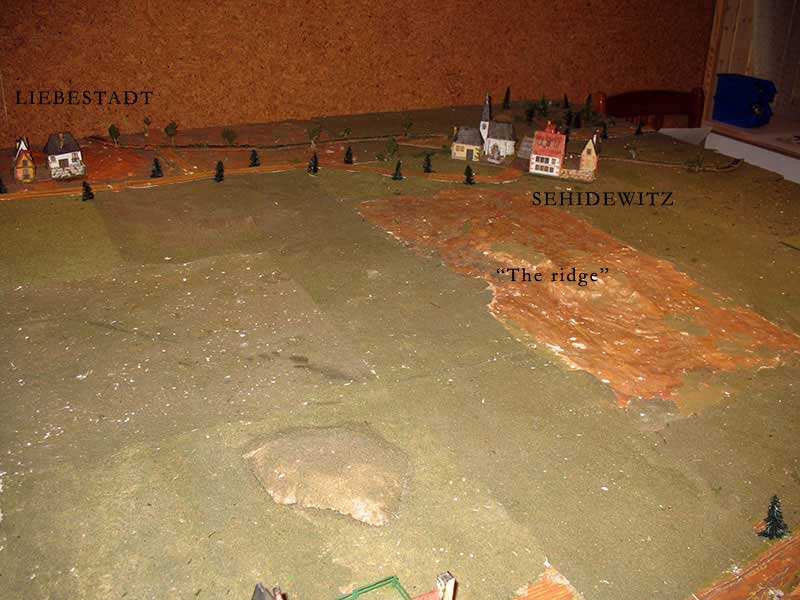 |
| The battlefield | |||
 |
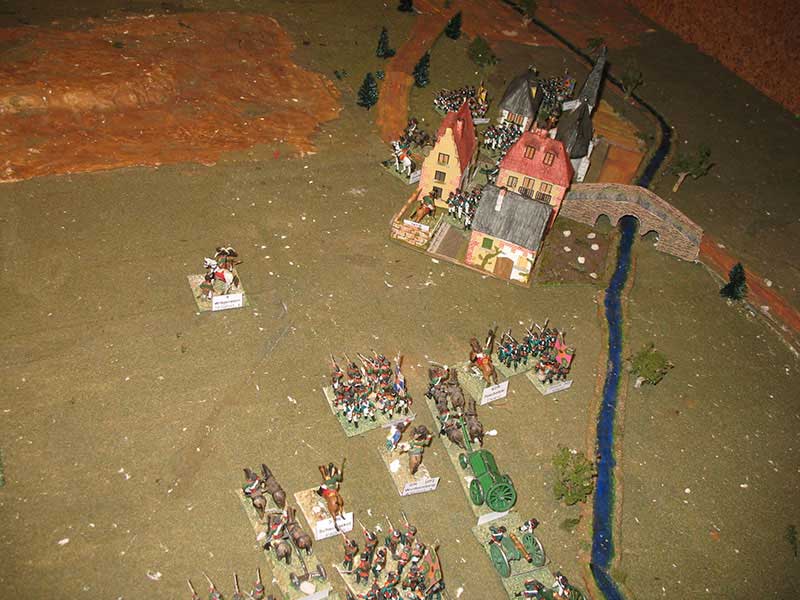 |
 |
 |
| The deployment | |||
DEPLOYMENT
French
The XIV Corps and the 20LC/I are on the table at the
start of the game. The rest of French units arrive in the following
order:
I Corps (-I) at A3-A4-A5 (20-50-30) 11.00 h
I Cavalry Corps (IC) at A1-A2-A3 (20-60-20) 13.00 h
2nd Guard Cavalry Division (2GC) h at A1-A2-A3-A4-A5
(20-20-20-20-20) 16.00 h
II Young Guard (2YG) at A1-A2-A3-A4-A5 (20-20-20-20-20) 16.30 h
Napoleon can start to dice for arrival in the 12.00 h. turn. The
first turn a "1" is required by rolling 1D10, the second turn a "2"
or less, the third turn "3" or less etc. until arrival.
Allied
All the Russian units and the Prussian Avant-Garde are on
the table at the start of the game.
The remaining Prussian units arrive at D1-D2-D3 (20-70-10) 11.00
h.
Barclay de Tolly can start to dice for arrival in the 12.00 h.
turn. The first turn a "1" is required by rolling 1D10, the second
turn a "2" or less, the third turn "3" or less etc. until arrival.
The numbers between parentheses are the probability percentages for the
actual arrival point of the first unit in the Corps or independent
division. The exact order of arrival must be diced out. The
following divisions can enter, after the previous one vacated the
arrival point. The Corps commanders always arrive with their second
unit. The artillery reserve will arrive only after at least two
units had arrived. Apply the OR 13.8.2 rule for Varying Time
Arrivals.
THE TRACHENBERG PLAN
This battle 'occurs' during the Campaign of Leipzig, so the
Trachenberg Plan marking the Allied strategy, will be of
application: direct confrontation with Napoleon himself would be
avoided, whereas isolated French Marshals and generals would be
attacked.
In order to simulate the effect of the Trachenberg Plan, the
following special rule will be used to see the time that Allied
staff takes in realizing the Napoleon's arrival:
"Every turn after the arrival of Napoleon, Barclay de Tolly, if
present in the battlefield, will throw 1D10. The first turn a "1" is
required, the second turn a "2" or less, the third turn "3" or less
etc. until successful. At this moment, Barclay de Tolly must to
order immediately a general retreat, leaving only a rearguard."
OPTIONAL COMMAND & CONTROL (from Alfonso
Peral a.k.a Lannes)
All upper-echelon commanders (Army, Wing, Corps) have
Command Points (CP) (highlighted
in green
in the
OOB): E:5, G:4,
A:3, P:2. Corps commanders have +1 and Napoleon has +2 additional CP
Wing and Corps Generals are activated by receiving 1 CP from the
C-i-C or by making a command test. If they are in command (either by
receiving 1 CP or by passing his command test), the General is in
command and gets all his CP´s, on the contrary he gets only one half
(rounding down).
Combat generals (i.e. Division or similar Generals) must to get
1 CP from his superior to be in command. On the contrary, they make
a command test as per the rules.
The flow of CP's must follow the chain of command and is only
possible
within the command radius. 1 additional CP must be spent for
distances until the double of the command radius.
VICTORY POINTS
The key points are the six end-roads and the percentage of
victory points allotted are A1 (20%), A4 (20%), C1 (10%), D2
(20%), D5 (20%) and B5 (10%). Every side owns initially their
respective arrival point. The French have 973 points and the Allied,
927. The multiplier for the weaker side (Allied ) is 1.05 in
NB1 and NB2 (475 and 190 victory points respectively).
HISTORICAL OUTCOME
This is a fictional scenario. In the real world, the Allied
always avoided battle by retiring behind the Bohemian mountains when
Napoleon advanced against them. After Napoleon returned to Dresden,
the Allied came again, thus maintaining busy to l'Empereur,
while the trap was closing around his neck.
BIBLIOGRAPHY
-
3rd Military Mapping Survey of Austria-Hungary
-
Nafziger G. ‘'Napoleon at Leipzig. The Battle of Nations 1813”, The
Emperor Press, Chicago, 1996
- Petre, FL 'Napoleon's Last Campaign in Germany, 1813', J. Lane,
1912
- Zucker, K.
1813. The Year that doomed the Empire. OSG, 2007
| GO TO THE BATTLE IN PICTURES |