fuentes de onoro (May 5, 1811)
The scenario for napoleon's battles
INTRODUCTION
Following the winter of 1810 spent by the Marshal
Massena’s Army of Portugal before the lines of Torres Vedras, the
French retreated into Spain leaving a garrison in the Portuguese
border fortress of Almeida. Wellington followed up with his British
Portuguese army and laid siege to Almeida, which had to be taken
before he continued his advance into Spain, a task in he was joined
there by Spanish guerrillas.
In April 1811 Massena advanced from Ciudad Rodrigo to relieve Almeida,
the move Wellington hoped Massena would make, although earlier than
he had expected. Wellington took position on the ridge above Fuentes
de Oñoro, ready to fight the form of defensive battle he fought so
effectively on many occasions
(taken from
British Battles)
The Order Of Battle is based on:
- "A
History of the Peninsular War", Volume IV,
C. Oman, Green Hill Books, 2005
- OOB's provided by George Nafziger
HOUSE RULES
The second edition of
Napoleon's Battles edited by Five Forks has been used (including
all the optional rules) with some slight modifications fully
explained in the
Fuentes pdf file and in the
Home-Rules
section:
1) The cavalry scale is also 1/120. To avoid
distortions, 2 figures were removed for each 3 casualties.
2) Units of cavalry from 480 men upwards are allowed
and units of infantry with less than four elements are also
allowed to display under-strength infantry units.
3)
Routed units can try to rally without an attached general
with an additional '-3' modifier.
4) Divisional batteries
are used (with a -1 modifier). The infantry fire is carried out as
usual, but the resulting losses are not marked on the target unit,
but are only used to cause disorder.
5) C-i-C ratings. Do
not use “10” as Response number of the C-i-C’s but use the
values assigned to them as Corps Commanders.
TABLE-TOP ADAPTATION
Fuentes pdf file
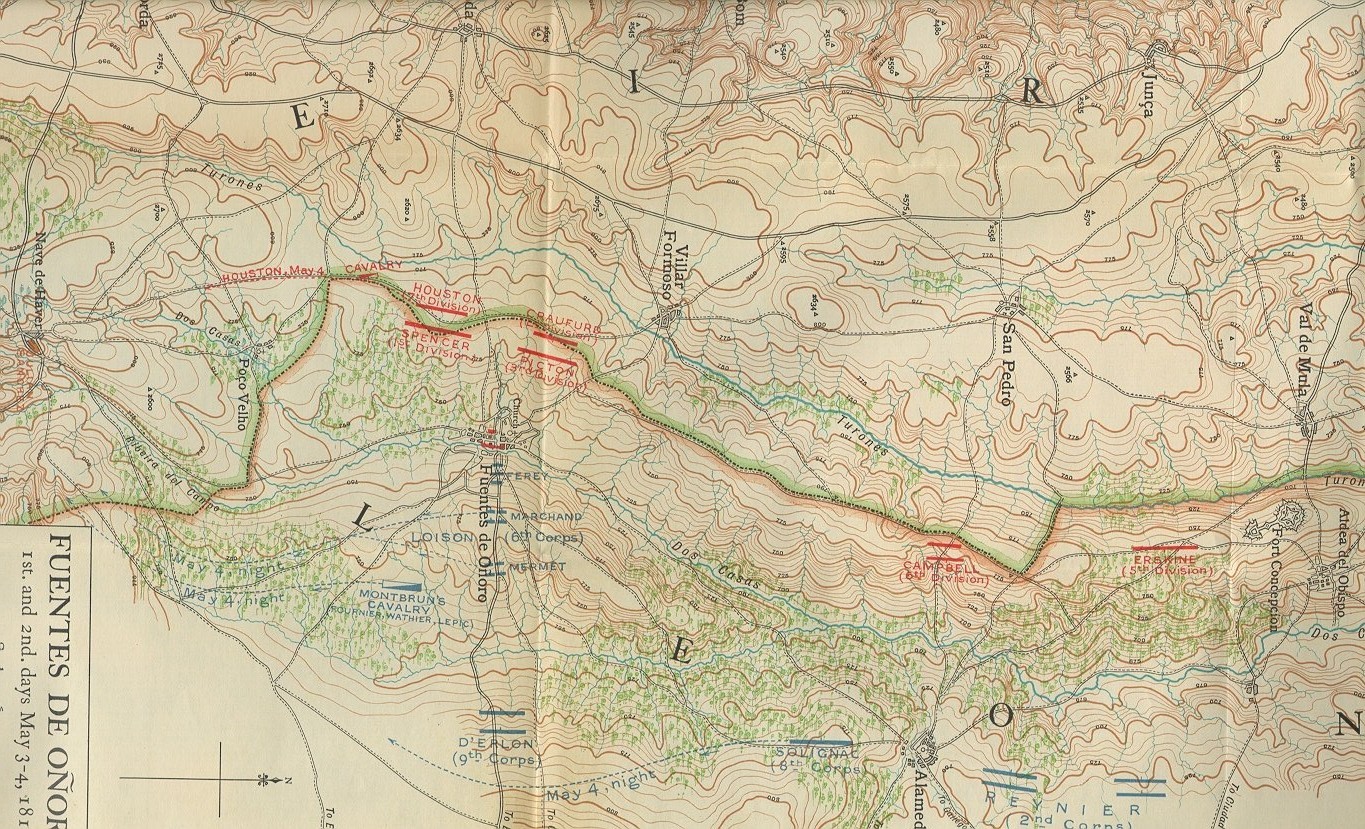
Old map
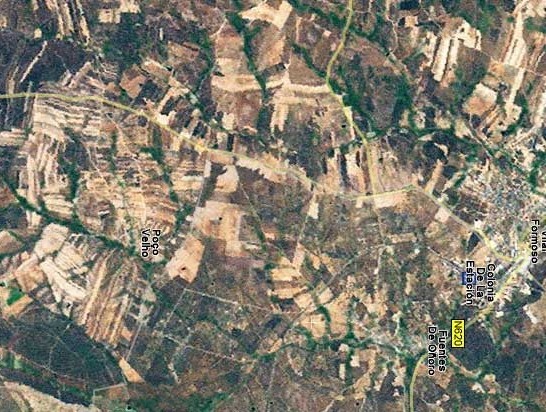
Yahoo aerial view
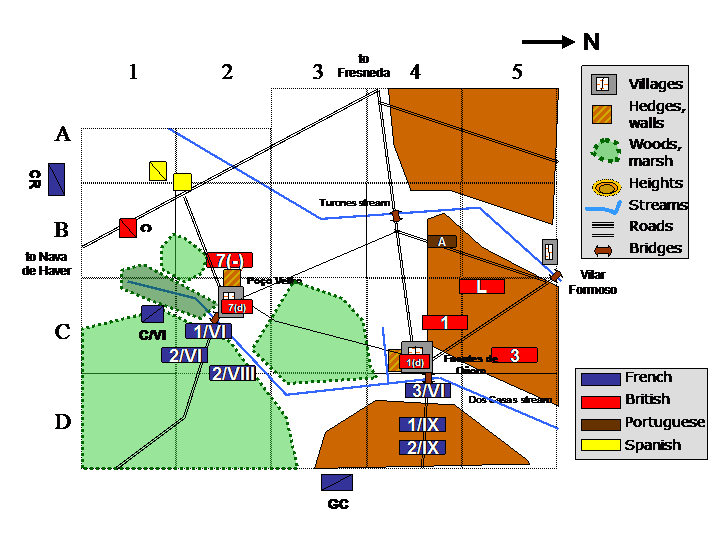
Game map

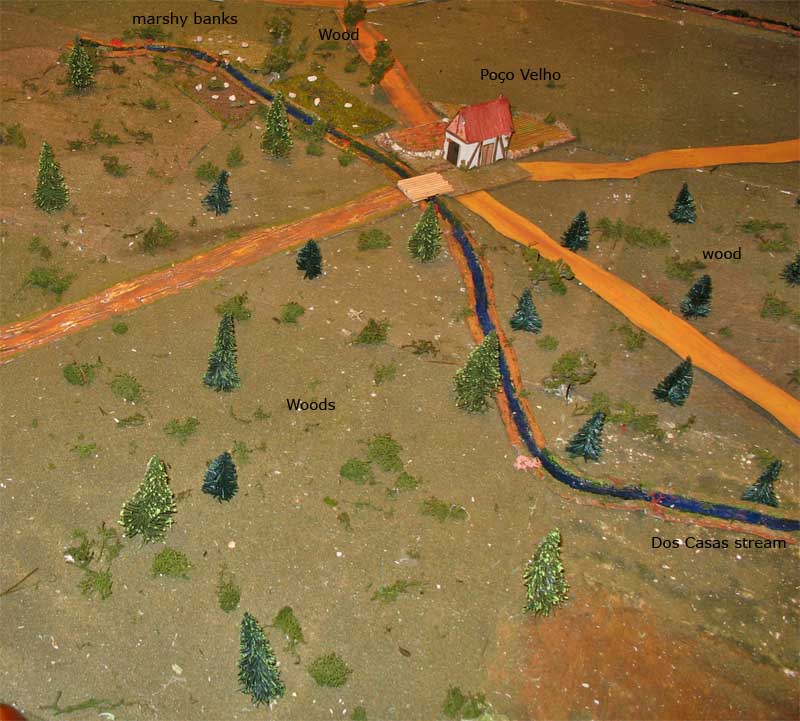
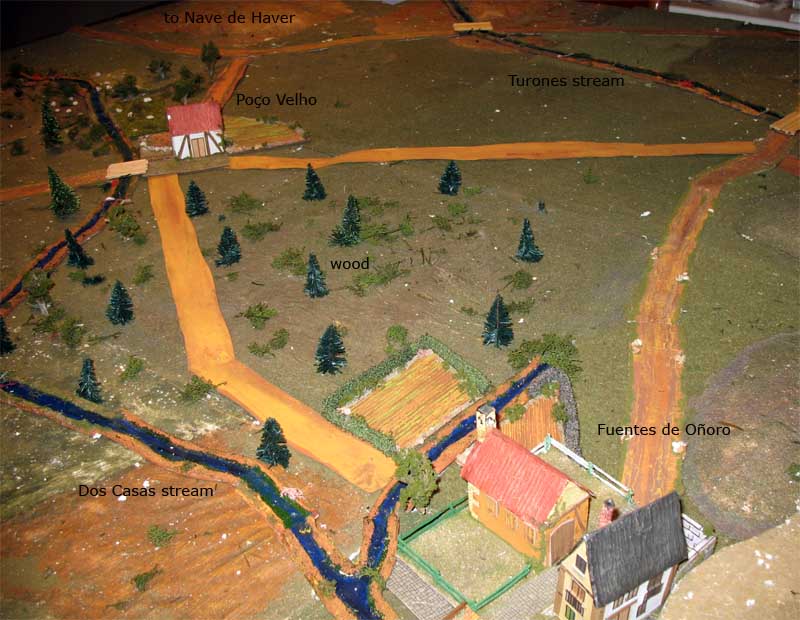
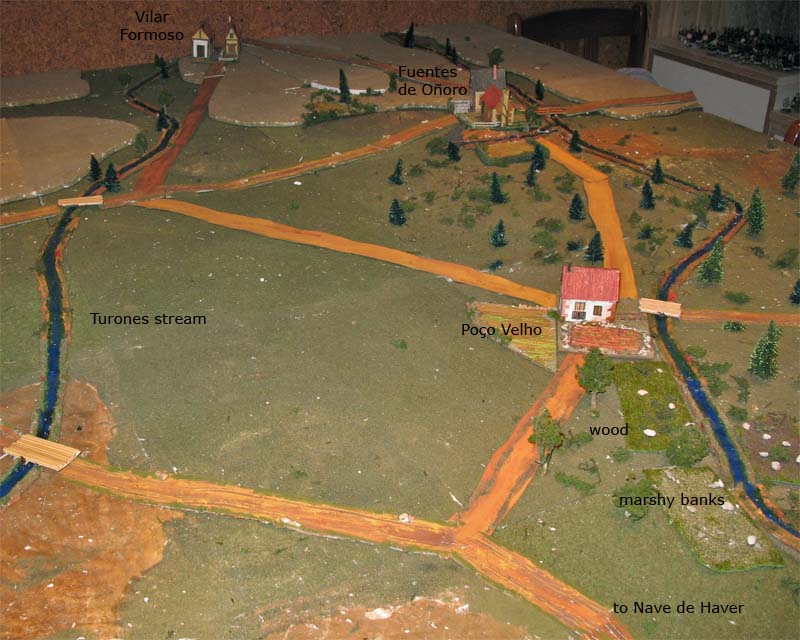
The
battlefield
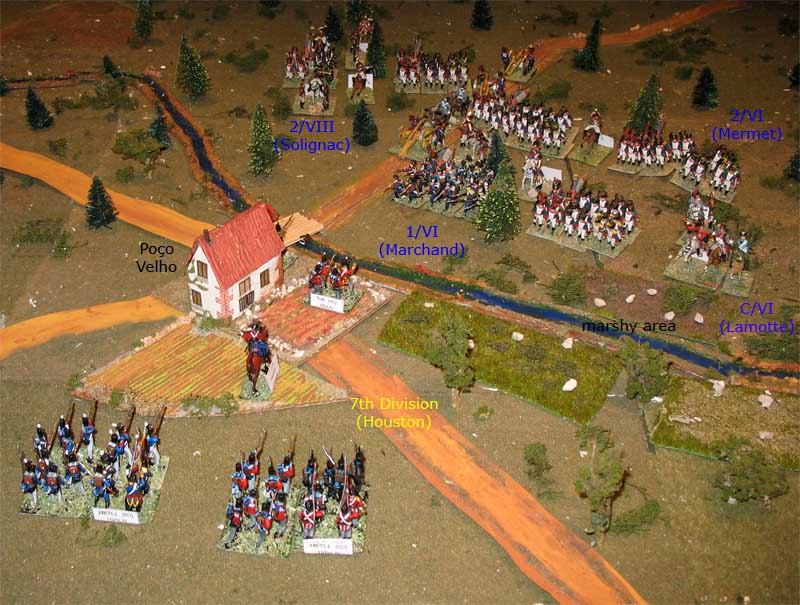
INITIAL DEPLOYMENT
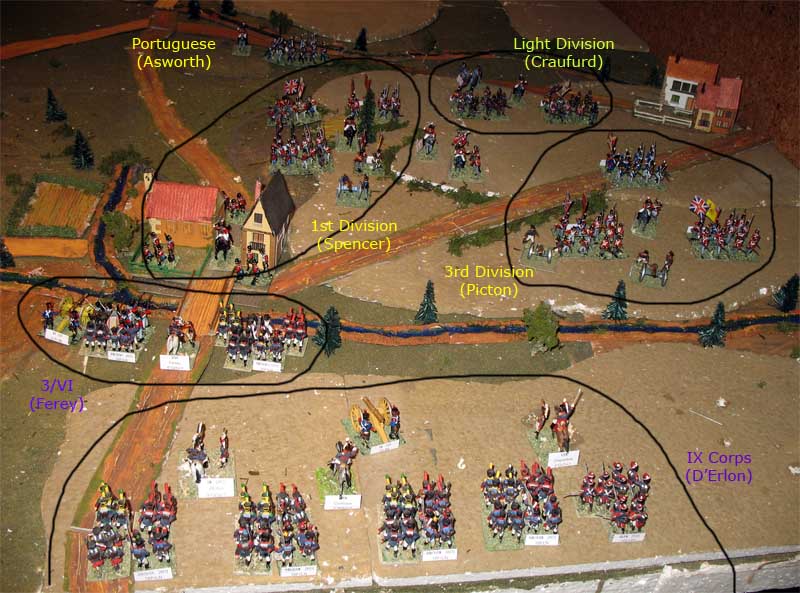
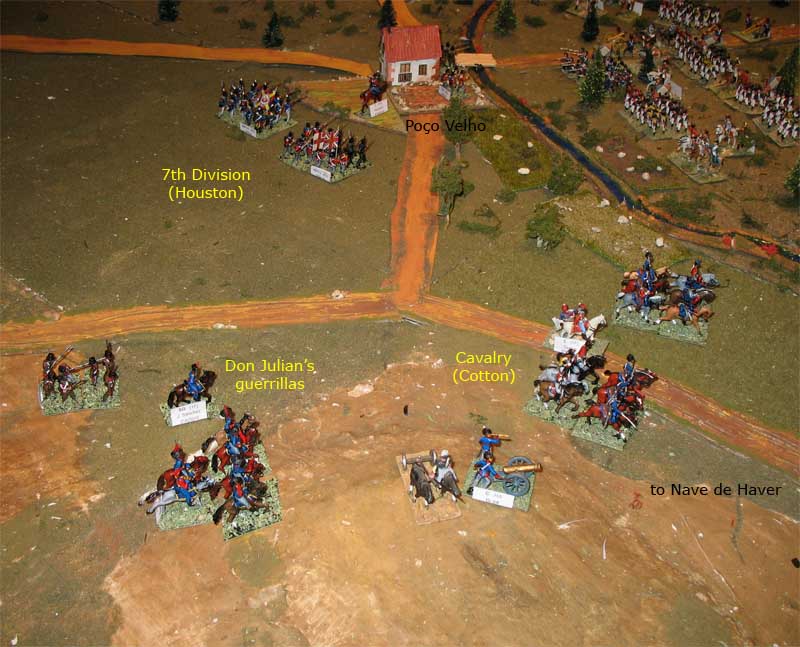
The French facing Fuentes
The French facing Poço Velho
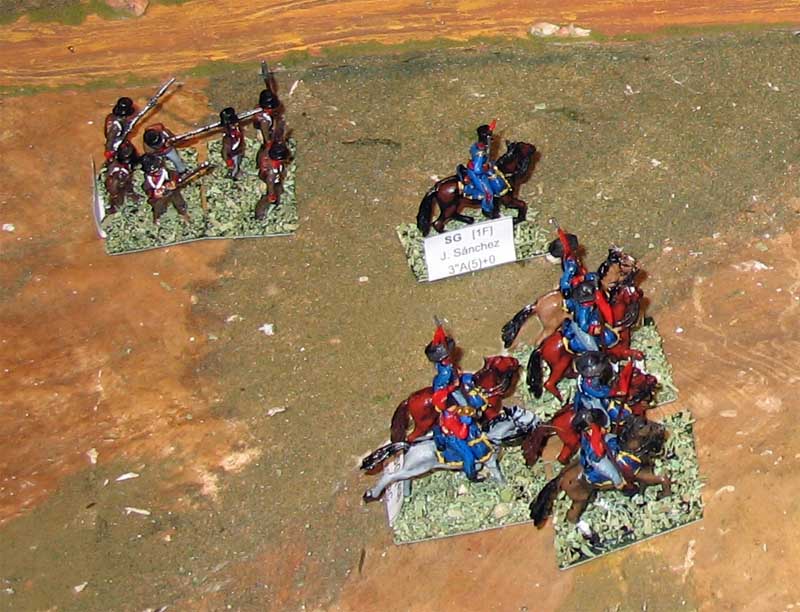
Guerrillas and Britsh cavalry
watching
Guerrilas of Don Julian
SPECIFIC RULES OF THE SCENARIO
Initial deployment
The map shows the situation at dawn of May 5. All the Allied units, with
exception of 5th and 6th Divisions are deployed in the table-game. The
French units present are the VI, VIII and IX Corps. For all
reinforcements apply the OR 13.8.2 rule for Varying Time Arrivals to
each unit listed separately (Roll 1D10 starting two turns before the
normal arrival turn. Two turns early a ‘1’ allows to enter; one turn
early ‘1’ through ‘3’; the same turn ‘1’ through ‘6’ and in later turns
‘1’ through ‘8’).
a) Historical (until the taking of Poço
Velho)
The Massena’s plan for the battle consisted of an
outflanking attack of the Allied left using the Reserve Cavalry, the VI
Corps (less the Ferey Division) and the VIII Corps (Solignac Division).
When this attack was well under way, the IX Corps and the Ferey Division
will take Fuentes de Oñoro breaking the angle of the new Allied line.
MeanwhileMeanwhile, the II Corps was fixing the 5th and 6th Allied
Divisions at the north of the battlefield (the numbers in parenthesis
are percentages of occurrence).
- 07.00 h. 1B/C/IX A1/B1 (30/70); 1B/CN
B1/C1 (30/70)
- 07.30 h. 1B/CR B1/C1
(30/70);
2B/CR
B1/C1 (30/70). Montbrun enters with the first
unit
- 09.30 h. 1B/GC, GC and Bessieres at D2/D3
(50/50). After the crossing at Poço Velho (Bessières must be present)
these units will follow the VIII or VI Corps (80/20).
The VIII Corps (Solignac Division 1/VIII and VIII Artillery) is behind
the VI Corps. Massena is with Solignac.
All units arrive
deployed or limbered (i.e. not in march column formation)
b) Historical with something of Artificial Intelligence?
After the taking of Poço Velho, the leading division of VI Corps must
choose one of the two roads leading north: western/east (90/10). The
second division will follow the first or will pass the same choosing
process than this last (90/10).
The VIII Corps (Solignac) will also choose one of the two roads
western/east (10/90). Bessières and his Guard units will follow the same
procedure than in the a) Historical option
c) The Wellington’s
theory
Wellington believed that Massena would make a frontal
assault against Fuentes de Oñoro, so their main force was massed in and
behind the village. In this variant Massena can only use a maximum of
two Divisions (dice for between VI and IX Corps) and the Reserve Cavalry
against Poço Velho. The chosen Corps commander acts as a positional Wing
Commander for these detached units, that deploy at C2/D2 (60/40).The
rest of French units deploy at D3/D4/D5 (30/40/30).
Calling the Reserves
The units located out of the table - 5th and 6th British Divisions
and the French II Corps were watching (and cancelling) each other
through the Dos Casas stream at north of the battlefield. In this
alternative Scenario, Massena could call one Division of the II Corps
(dice for which) that will enter at D4. For it, Massena must to pass a
command control test (or be in command if using 3.6.3) and send a
messenger. Two turns after this last leaves the table, the Optional rule
for Varying Time Arrivals can be start to be applied. A turn after the
arrival of the French reinforcements, Wellington could start the same
procedure calling an only Division (dice for). The Allied units enter at
A5.
The behaviour of Bessières
This Maréchal was very
reluctant to aid Massena. To simulate this attitude during the battle,
his Command Radius has been lowered to 4” (i.e. like a Division General)
and the Command Radius of Massena has no any effect on him
The Duke of Wellington
Use the optional rule that allows
marking Wellington as ‘React’ if not moved during his side’s movement
step
VICTORY POINTS
The village of Fuentes is worth 30% of total victory points, the
village of Poço Velho 15%, the bridge and crossroad at B4
25%, the A3 end road 10% and the bridge at Vilar Formoso at B5
20%. The multiplier for the weaker side (Allied) is 1.5. All Objectives
are Allied controlled at the start
THE BATTLE IN PICTURES