le bois de paris (june 18, 1815)
A Prelude to Plancenoit
INTRODUCTION
This small solo
scenario is an adaptation of the Rich Barbuto's scenario published
in Lone Warrior #147 and #148 issues, that I downloaded in 2004 from
the now defunct Magweb site. Using the Barbutto’s words:
“This solo battle is a “what if” scenario. What if the Prussians had started
toward Plancenoit a few hours early and what if Napoleon had sent
forces to dispute the Prussian advance east of Plancenoit. The fight
would be between well concealed French forces firing out of woods
against the heads of thin columns of slow-moving infantry”
The scenario involves the Prussian 15th and 16th Brigades
and the French VI Corps and the Domon Light Cavalry Division.
Bibliography
- Rich Barbuto's Scenario
http://www.rafaelpardoalmudi.com/docs/Paris_Wood_LW.pdf
- Peter Hofschröer,
1815: The Waterloo Campaign. The German Victory. GreenHill
Books 1999
- Jean-Philippe Tondeur, Patrice Courcelle, Jean-Jacques Pattyn et
Paul Meganck,
Plancenoit. Waterloo 1815. Les Carnets de la Campagne - nº 6. Editions de
La belle Alliance, 2003.
TABLE-TOP ADAPTATION
GO
TO THE BATTLE IN PICTURES


Barbuto's map
Prussian flank march to Waterloo
Game map


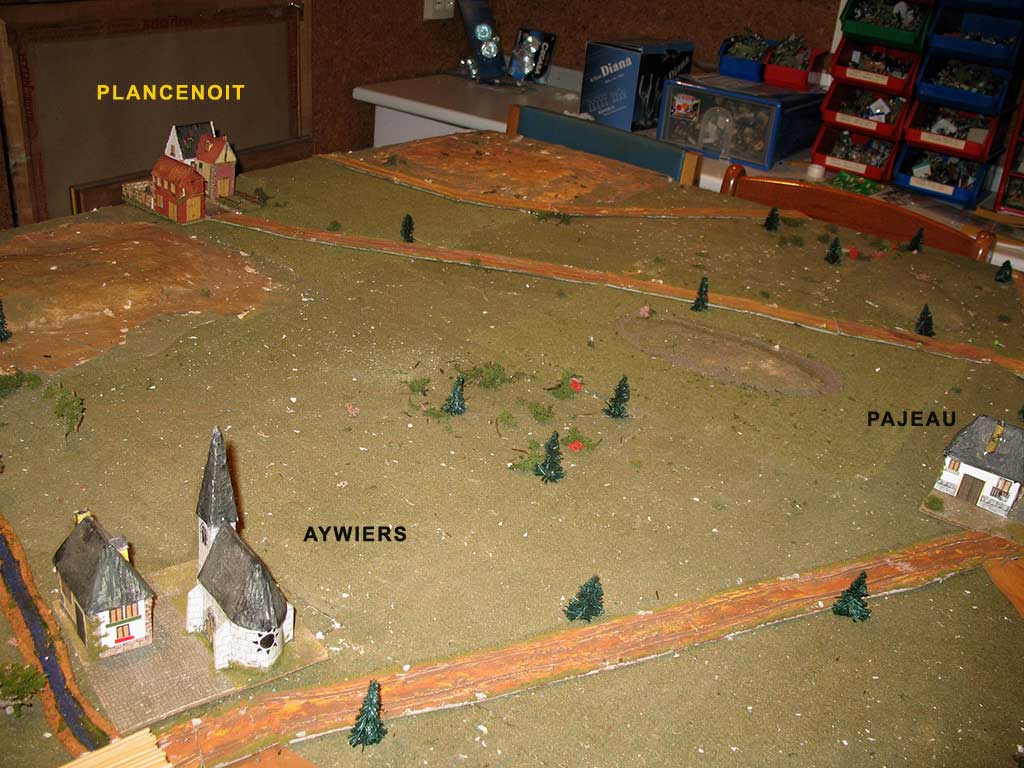
The actual battlefield
Scenario pdf file for 'Le Bois de Paris'
GO
TO THE BATTLE IN PICTURES
Summary of the oob
Prussian IV
Corps:
(Army Moral 34; Break point 13)
C-i-C
Bulow
15th Brigade
Losthin
- Infantry: 9 battalions, 1 foot battery
- Cavalry: 3 regiments, 1 horse battery)
Reinforcements
16th Brigade Hiller
- Infantry: 3 battalions, 1 foot battery, 1 heavy foot battery
French VI Corps (Army Moral 36; Break point 12)
C-i-C Lobau
19th Division
Simmier
- Infantry: 9 battalions, 1 foot battery
3rd Light Cavalry Division Domon
- Cavalry: 3 regiments, 1 horse battery
Reinforcements
29th Division Jeanin
- Infantry: 4 battalions, 2 foot battery, 1 horse battery
Notes
Notes The basic duration of the game is 24 Turns (3 hours). Bonus Turns
are allowed rolling 2D6 ( p. 66 of the e-Lasalle book). The Prussians
are the first side..
OPTIONAL RULES
Prussian formations
The Prussian 15th Brigade is formed in two
columns. Each column has a single advance guard and one or
two flank guards, in order to advance along the four possible roads (see
the map).
The order of march of the infantry,
artillery, and cavalry within each column,
cannot be changed until after the forces had actually entered
the battlefield. Artillery can go only in the high road.
Generals Bulow, Losthin and Hiller will advance trough the high road.
The units of the Prussian 15th Brigade will
continue arriving in continuous column(s) untilthe full
brigade is on the table.
French units and formations
The French units covering the approaches to Plancenoit are random
managed. The general sequence is:
(1) At the start of each French turn, roll 1D6
to see if a French force shows up on the board that turn. A
result of 1 to 4 means that a French force appears.
(2) Roll 3D6-2 to determine the map point where
this force appears (see final Note)
No French forces can be placed behind a Prussian force, i.e. a location
that the Prussians have already "cleared".
For example, if a Prussian column has passed through checkpoint 5 en
route to checkpoint 6, then a French force cannot be placed at point 5.
When this anomaly occurs, the French force is placed at checkpoint 12
o13.
(3) Roll 1D6 for the composition of the French
force, according to the following table.
1: 1 infantry battalion
2: 1 infantry battalion
3: 1 infantry battalion
4: 1 cavalry regiment
5: 1 cavalry regiment
6: 1 artillery battery same type that its support (see later)
There are the following restrictions:
- French cavalry and artillery are not allowed in woods, so if the
location is in the woods and the roll indicates cavalry or artillery,
then roll again until you get an all-infantry result-
- If "1 artillery battery" result is rolled, roll 1D5 and go through the
table to find the artillery support. (All the die rolls can be made with
"physical dice", with exception of this last, that must be made with
EXCEL: I have don't found D5 dice!)
The French units are taken from the 19th division of the Lobau’s VI
Corps or from the 3rd Light cavalry division.
If in the open, the French force starts in attack column facing in the
most advantageous way. It can use subsequent turns to put itself in the
best offensive or defensive posture. If the French force appears in a
wood, chose the best position to block a road. Often that means placing
the unit along the front edge of the wood.
The wood is cleared
Prussians actions
After the Prussian forces arrive to the edge of the woods and advance
beyond (A3-D3 line) and the full 15th Brigade is on the table, the
16th brigade reinforcements can
enter the tabletop at the A5/B5 (60/40) roads in march column formation,
with infantry in front and the two batteries interspersed between the
battalions.
French actions
In the following French turn to the Prussian deployment beyond the wood,
the rest of the French
infantry/cavalry/artillery units not present in the table, will arrive
deployed in attack column/waves/limbered formation at
A1/B1/C1 (33.3 /33.3/33.3).
Only one French unit may arrive in each turn. The
actual arriving unit will be diced out amongst the
non-arrived ones, with the divisions having at least one unit in the
table having priority.
Victory conditions
The object of the game is for the Prussians to attack Plancenoit,
therefore the game is immediately finished when
a Prussian battalion assaults the village with a Prussiana
decisive victory. Any other end-game situation is managed as per the
standard Lasalle rules.
Note
The 3D6-2 (the sum of three six-sides dice minus two) distribution gives
an approximate triangular distribution with the central values having a
higher probability of appearance than the extreme ones. See the
accompanying diagram.

See a story version at the
Project Leipzig (1813)
blog
THE BATTLE IN PICTURES